

Sensors | Solution Overview
Y6OS supports Modbus RTU, enabling integration with a wide range of environmental and industrial sensors. From air quality and vape detection to power meters, solar systems, and industrial controls, if it integrates with Modbus, it can connect to Y6OS.
In addition to Modbus RTU, YourSixOS, supports integration of native environmental sensors, such as the AXIS D63 series.
Overview
Sensors provide real-time insight into physical and environmental conditions by measuring values such as temperature, humidity, air quality, pressure, and fluid levels. Unlike traditional event-based devices that simply indicate whether something has happened, sensors quantify conditions and trends, delivering meaningful operational context. This additional intelligence helps organizations better understand their environments, make informed decisions, and respond proactively to changing conditions.
Why Use Security Sensors?
-
- Gain visibility into environmental and operational conditions across facilities and assets
- Provide alarm operators and end users with greater situational awareness during investigations and incident response
- Enhance physical security and safety by adding context beyond standard alarms and events
- Monitor critical measurements such as temperature, humidity, air quality, pressure, fluid levels, and more
Answer important operational questions including:
-
- How warm is the environment?
- How humid is the area?
- What is the battery level?
- What is the current fluid level?
- What is the air quality?
- Are conditions changing over time?
By combining sensor data with video, audio, access control, and other security technologies, organizations can create a more complete operational picture and improve response times, efficiency, and overall awareness.
Sensor Applications
Sensors extend physical security beyond video by providing real-time insight into the environmental and operational conditions that matter most. By bringing sensor data into Y6OS alongside video, access control, audio, and other security devices, organizations can monitor more of their environment from a single platform.
-
- Mobile Security Units – Expand the capabilities of mobile and temporary security deployments by monitoring environmental conditions, power systems, battery levels, equipment status, and other critical measurements. (More information about MSUs)
- Restrooms and Private Areas – Gain awareness in areas where video surveillance may not be appropriate. Monitor air quality, vape detection, temperature, humidity, occupancy-related conditions, and other environmental factors without relying on cameras.
- Utilities and Critical Infrastructure – Monitor fluid levels, pressure, temperature, power consumption, and other critical operational conditions at remote or unmanned facilities.
- Warehouses and Cold Storage – Track temperature and humidity to help protect temperature-sensitive inventory and identify changing conditions before they impact products or operations.
- Manufacturing and Industrial Facilities – Monitor equipment and environmental conditions such as temperature, pressure, air quality, and fluid levels to improve operational awareness and support proactive response.
- Agriculture and Controlled Environments – Monitor temperature, humidity, water levels, and other environmental conditions that can impact crops, livestock, equipment, and facilities.
- Commercial Buildings and Facilities – Monitor indoor air quality, temperature, humidity, water conditions, and other building systems to provide greater visibility across distributed locations.
- Remote and Unmanned Sites – Combine sensors with video and other security technologies to gain a more complete understanding of conditions at locations where personnel may not be regularly present.
- Connected Vehicles – Monitor GPS location, speed, vehicle health, and other operational conditions through connected vehicle telemetry. When combined with peripherals, organizations can also monitor ignition status, turn signals, brake pedals, horns, and other vehicle inputs alongside onboard video and audio for a more complete view of vehicle operations.
From a restroom to a remote utility site or mobile security unit, sensors enable organizations to monitor conditions that cameras and traditional security devices cannot see—bringing physical security and operational intelligence together in a single platform.
Beyond Traditional Alarm Monitoring
Traditional alarm systems tell you when something crosses a line. Y6OS Sensors tell you what’s actually happening. A conventional alarm panel typically reports a simple condition—normal, alarm, or trouble. An operator might receive “Zone 7 Alarm,” but that event provides little context about what caused it or how the condition is changing. Y6OS Sensors go further by providing the actual measured value and the historical data behind it.
-
- Go beyond (Traditional alarming): Zone 7 Alarm
- Know what’s actually happening (Sensors in Y6OS): 47°F — up 9°F in 40 minutes
Know the value. See the trend. Understand the direction. Then use video and other connected devices in Y6OS to see what was happening when the event occurred. It’s more than knowing a threshold was crossed. It’s having the context to understand what’s happening and make a more informed response.
Turn Sensor Data Into Action
The real power comes from connecting sensor intelligence with the rest of Y6OS. Instead of treating sensors as a standalone system, sensor events can become part of a broader security and monitoring workflow.
-
- Turn sensor conditions into actionable events using alarm rules and automated workflows.
- Add video verification to give operators immediate visual context when an event occurs.
- Use adjacency to connect sensors with nearby cameras, doors, speakers, and other devices.
- Integrate sensor events into professional monitoring workflows for notification, escalation, and dispatch.
- Bring sensors, video, access control, audio, and monitoring together in one unified platform.
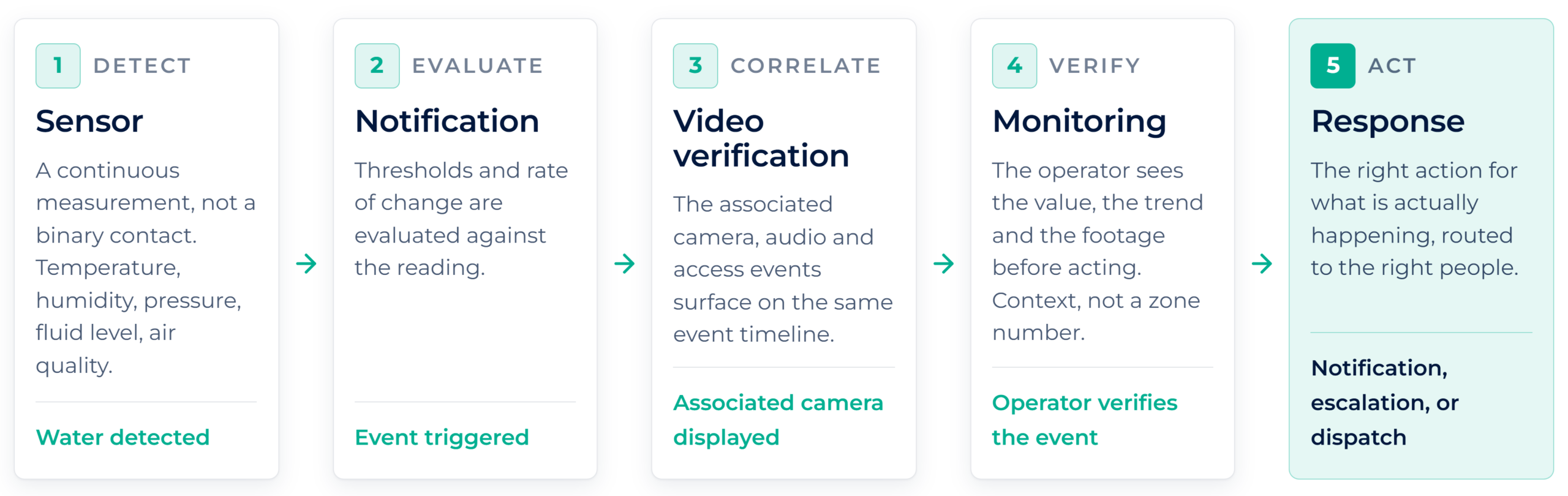
Peripherals vs Sensors
-
- A peripheral indicates if smoke is present, if it is hot, or if the liquid level is low – (Binary)
- A sensor measures how much smoke there is, how hot it is, and the exact liquid level – (Continuous)
Sensor Integration Options
Native Sensors
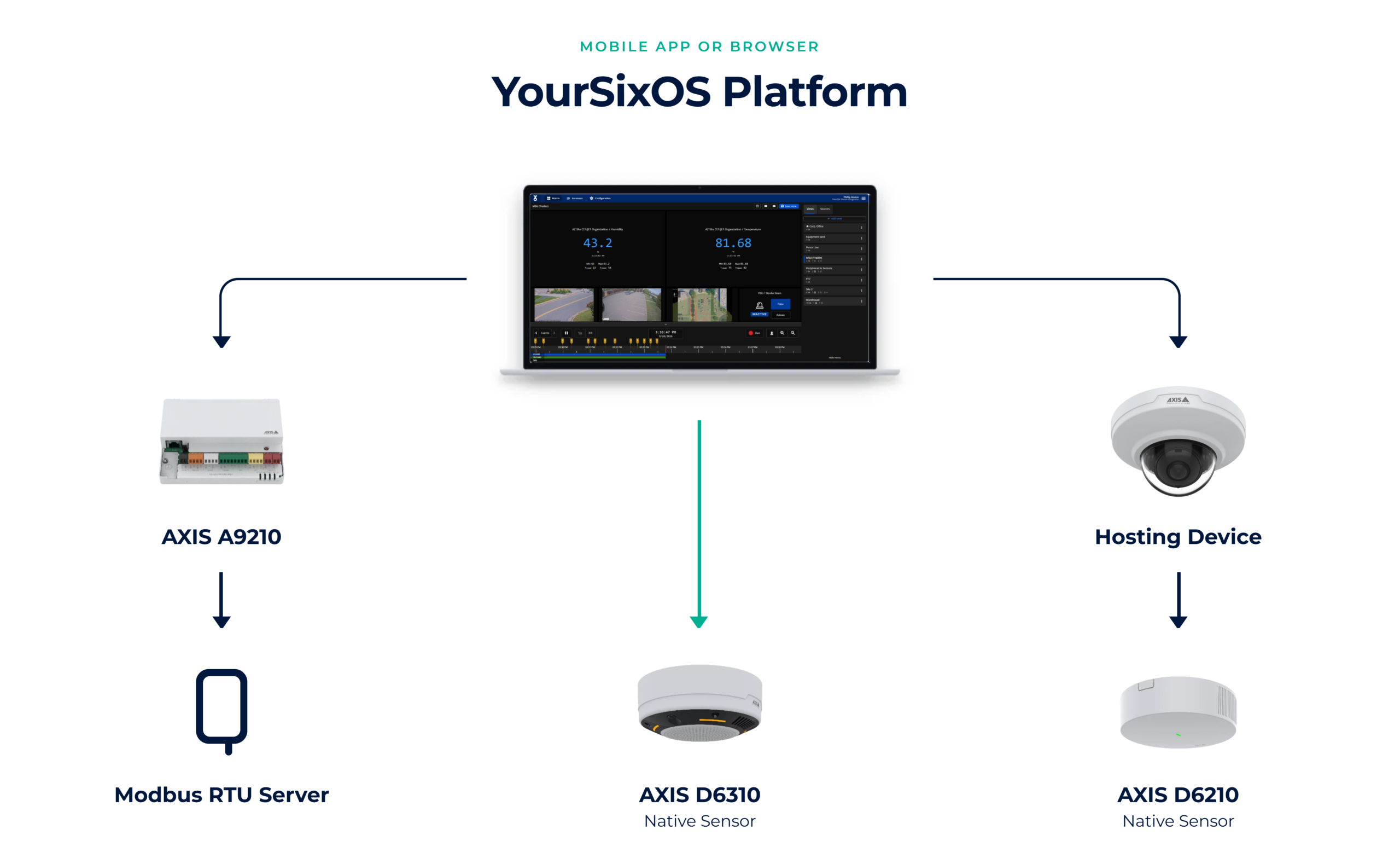
Native sensors run directly on a supported device and communicate with YourSixOS without requiring additional hardware. These sensors are ideal for simple deployments where environmental data is collected directly from the device itself. For example, the temperature sensor built into an AXIS D6310 can report environmental conditions directly to the platform. Additionally, the AXIS D6210 is supported when using a hosting device to connect the sensor to YourSixOS.
Modbus RTU Sensors
Modbus RTU sensors connect through a Modbus RTU server that is physically wired to a gateway device, such as an AXIS A9210, enabling organizations to integrate a wide variety of third-party industrial and environmental sensors into YourSixOS. This flexible approach supports a broad ecosystem of Modbus-compatible devices and is ideal for industrial, utility, and facility monitoring applications. Through a single gateway, organizations can collect and monitor specialized data such as fluid levels, pressure, air quality, temperature, humidity, power consumption, and more, while easily scaling deployments to support multiple sensors across a site.
Axis D63 vs Modbus RTU: Which solution is the one for me?
Sensor Subscriptions
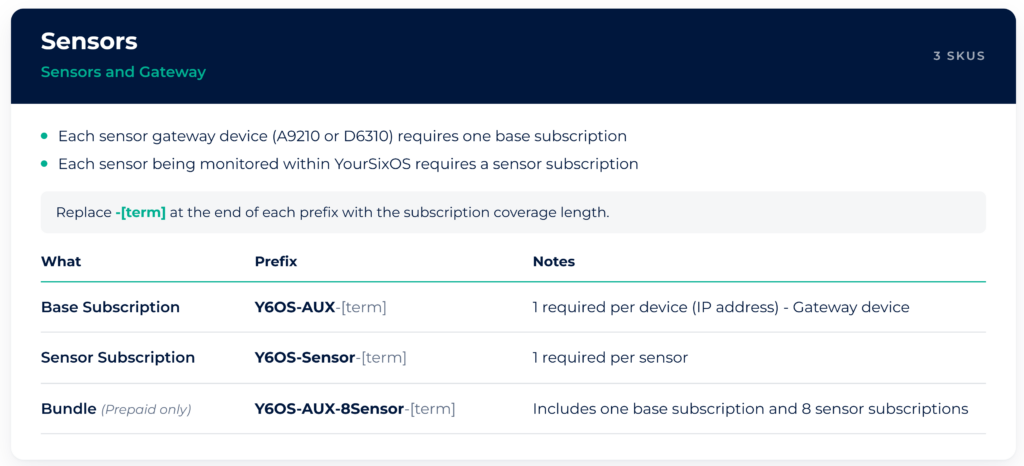
Sensor subscriptions in YourSixOS are structured in two layers and it is important to understand both when planning a deployment.
Base Device Subscription: One subscription for the gateway or sensor host device (A9210, D6310, etc.)
-
- Every sensor deployment requires a subscribed hardware device (Base device subscription) that serves as the connection point to the platform. For Modbus RTU sensors, this is the Axis A9210 gateway device. For native Axis sensors, such as the D6310, the D6310 is the gateway device and also requires a subscription.
- Example product ID (SKU) for a base device: Y6OS-AUX-“X” (“X” represents the subscription term)
Sensor Subscription: One subscription for each individual sensor being monitored within YourSixOS
-
- In addition to the device subscription, each individual sensor requires its own sensor subscription. This allows organizations to scale deployments by adding multiple sensors to a single gateway while maintaining visibility and management of each sensor independently within YourSixOS.
- It is also important to understand the difference between a Modbus server and a sensor. A Modbus server is the physical device that communicates on the Modbus network and exposes data through registers. A sensor is an individual measurement created from one or more of those registers. A single Modbus server can contain many sensors, such as temperature, humidity, pressure, wind speed, fluid level, or air quality measurements.
- Example product ID (SKU) for a sensor: Y6OS-Sensor-“X” (“X” represents the subscription term)
For example, a single subscribed A9210 gateway may connect to a weather station that operates as one Modbus server. That server may provide multiple sensor readings including temperature, humidity, barometric pressure, wind speed, and precipitation. While only one device subscription is needed for the A9210 (Y6OS-AUX), each configured sensor within YourSixOS requires its own sensor subscription (Y6OS-Sensor).
Bundled Subscriptions
Prepaid bundled subscriptions are available through distribution. Each bundle includes the base device subscription along with support for a specified number of sensors. (Y6OS-AUX-8Sensors-“X”)
Understanding the difference between device subscriptions and sensor subscriptions is essential for accurately sizing and pricing a sensor deployment.
Verified Sensors
Explore our Verified Components list to find sensors and other hardware components that have been tested and proven to work well with YourSixOS. View compatible manufacturers and models to help select the right components for your deployment.
Learn More
-
-
- Solution: Integrated Security Sensors for Cloud Surveillance – YourSix
- Manual/Guides: Managing sensors – YourSixOS Documentation
- Technical Reference: Sensors – YourSixOS Documentation
- Videos: Sensors – YouTube
- Additional Insights: Sensors – Blog
- Verified Sensors: Verified components
-